Start with the garment, not the bag price
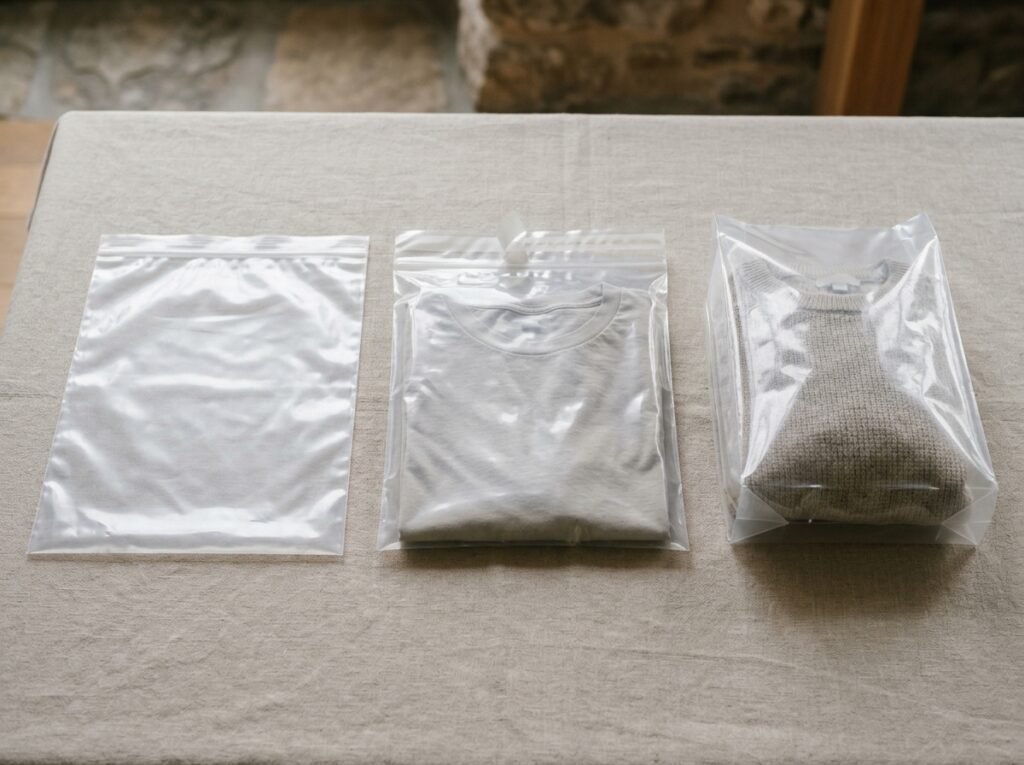
Two clear garment bags can look almost identical but serve different packing operations. A folded shirt destined for a retail carton, a garment transported on a hanger and a product needing a resealable flap may each call for a different construction. The lowest price per piece is only meaningful after the bag type, measurements, film and finish have been agreed.
Before contacting a supplier, identify the garment type, how it will be folded or hung, whether the package needs an opening for a hanger, and whether the bag will be sealed during packing. Note whether branding, product identification or ventilation openings are part of the approved design.
Compare the main LDPE bag formats
The LDPE Poly Bags range includes multiple constructions. This comparison can help buyers narrow the enquiry before discussing production details.
| Bag format | What distinguishes it | Details to confirm |
|---|---|---|
| Flat bag | Simple flat construction for packing a suitable item | Finished width and length, opening position |
| Self-adhesive bag | Flap with an adhesive closing arrangement | Flap depth, adhesive position and closure design |
| Printed bag | Film carrying buyer-approved artwork | Print colours, placement, artwork and print area |
| Gusseted bag | Added room provided by a gusset | Gusset type, depth and finished measurements |
| Hanger bag | Designed around a hanging garment arrangement | Hanger opening and relevant dimensions |
| Perforated bag | Includes an agreed perforation pattern | Hole size, placement, quantity and purpose |
A bag may combine more than one feature—for example, a printed self-adhesive garment bag. Specify all relevant characteristics instead of assuming the format name covers them. Film or tubing supplied on rolls is also different from a ready-made finished bag; confirm which product the quotation describes.
Measure the finished bag correctly
The most common quotation problem is incomplete measurement information. “60 × 40 cm bag” does not tell the supplier whether the first number is length or width, whether the flap is included, or whether the size is measured flat. Use a simple drawing with arrows or a measured reference sample.
Provide the finished flat width, finished length, flap dimension if applicable, and gusset depth where relevant. For hanger bags, mark the intended opening. If the garment is folded, supplying the actual folded garment dimensions helps explain the allowance needed around it. Avoid guessing an extra allowance without considering the garment and the intended packing process.
When comparing quotations, request the same unit system and the same definition of dimensions from every supplier. Include any required dimensional tolerance in the approved specification.
Understand material and thickness
LDPE refers to low-density polyethylene. Buyers may request clear, coloured, printed or recycled-content options, but the appropriate construction depends on the product and packing operation. Film thickness is often stated in microns (µm), while some buyers use millimetres. For reference, 50 µm equals 0.05 mm. This is a unit conversion, not a recommended thickness for every garment.
A reliable comparison needs the material grade or composition, nominal thickness and agreed tolerance. Do not assume that identical thickness figures guarantee identical performance: film composition and construction can also matter. Where recycled content is requested, specify the percentage, whether it must be post-consumer recycled material, and what evidence the buyer requires. Environmental or regulatory claims should be supported by documentation for the actual product.
Plan printing and closure before approving artwork
For custom printing, send vector artwork where available, specify the number of print colours, and mark the print position relative to seams, flaps and openings. Confirm the approved colour reference, dimensions and any proof or sample-approval steps. DV Trims’s documented range includes printed polyethylene bags with printing options up to four colours, subject to the agreed product requirements.
For self-adhesive bags, discuss the flap and adhesive placement separately from the artwork. A request for “self-seal” is not enough to establish the exact closing construction. Buyers should also consider how the bags will be handled during packing and whether the closure is intended to be reopened.
Compare quotations on the same basis
Before choosing a supplier, make a simple comparison sheet covering bag type, finished size, film thickness, printing, quantity, packing method, delivery term and destination. A price quoted for an unprinted flat bag should not be compared directly with a printed bag with an adhesive flap. Check whether the unit price includes individual packing, export cartons or other agreed packaging.
The garment’s inner poly bag and the shipping carton’s closure serve different jobs. If your order includes export cartons, see our separate guide to choosing packaging tape for carton sealing.
Buyer checklist: what to send in an RFQ
- Garment type and intended packing method
- Bag format, dimensions and labelled sketch or reference image
- LDPE material, nominal film thickness and any required tolerances
- Flap, gusset, hanger opening or perforation details, if relevant
- Clear, coloured or printed finish and approved artwork
- Estimated order quantity, packing method and shipping destination
- Any documentation or sample approval requirements
Example enquiry format: “Please quote a transparent LDPE self-adhesive garment bag. Finished width: [ ] cm; length excluding flap: [ ] cm; flap: [ ] cm; film thickness: [ ] µm; print: [none / artwork attached]; quantity: [ ]; delivery destination: [ ]. Please confirm construction, packing and quotation terms.”
Frequently asked questions
Is a thicker bag always the better choice? Not necessarily. Suitability depends on the garment, handling requirements, film construction and buyer specification. Compare approved samples when performance matters.
Can a bag be both printed and self-adhesive? These are separate characteristics and can be discussed together in the same enquiry, subject to production confirmation.
Should I send a photograph or a drawing? Both can help, but a dimensioned drawing or measured sample is more reliable for confirming the final construction.
Explore the full LDPE garment packaging category or use Request Samples if you need to discuss a particular bag construction before placing an order.