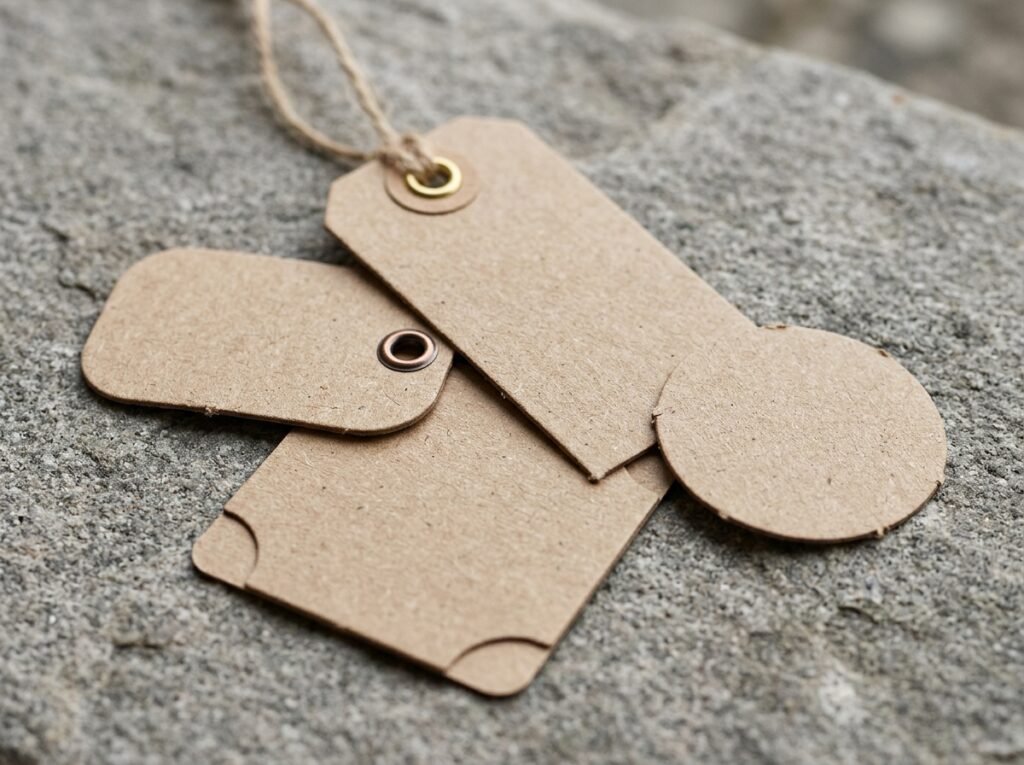
Two items, two different jobs
Hang tags and garment labels are often described together as “garment accessories,” but they have distinct functions. A hang tag is normally a removable presentation or product-information item. A garment label may communicate care, size, barcode or inspection information as part of an agreed apparel workflow. Treating them as one printing product can lead to mismatched artwork, material or quantities.
A useful sourcing plan starts by identifying where the item will be attached, who will read it and what information it must carry.
Hang tags vs garment labels at a glance
| Question | Hang tag | Garment label |
|---|---|---|
| Main role | Removable brand or product presentation | Care, size, identification or workflow information |
| Common substrate | Paper or paperboard, depending on specification | Paper, satin or other approved material |
| Typical artwork | Branding, price or marketing information | Approved data, symbols, sizes or item codes |
| Key production detail | Shape, printing, finishing and attachment arrangement | Readability, dimensions, data accuracy and application format |
| Main approval check | Appearance and version control | Correct information and final-use suitability |
These are typical distinctions, not universal rules for every garment programme. The buyer’s specific application determines the final construction.
What to include in a hang tag specification
The Hang Tags & Printing range includes hang tags, price tags, barcode tags, photocards, printed stickers and carton stickers. When requesting a quotation, make clear which of these items you need. “Hang tag” does not tell the supplier whether the item requires a particular shape, size, paperboard grade, surface finish or attachment provision.
Supply finished dimensions and artwork with the requested number of colours. Mark any holes, folds or custom-cut areas on a drawing. If a string or other attachment method is needed, identify it as a separate requirement rather than assuming it is included. Ask the supplier to confirm which finishing options are available for the specific design.
What to include in a garment label specification
The Garment Labels range covers care, size, barcode, joker and QC labels. The first question is which information the label needs to carry. Care information should come from the buyer’s approved instructions, and barcode data should come from a validated product-data source.
Materials such as paper and satin may serve different purposes. Finished dimensions, print clarity, intended application and quantity by version should be confirmed before quotation. For a closer look at each category, read our guide to care, size, barcode and QC labels.
Why a shared artwork file can cause problems
For a clothing collection, the same brand mark may appear on a hang tag, a price tag and a garment label. That does not mean a single production file is sufficient for all three. Each item can have a different print area, size, legibility requirement and variable data.
Use a small artwork schedule instead:
| Item code | Product | Artwork version | Quantity |
|---|---|---|---|
| HT-01 | Main hang tag | Brand design A | [ ] |
| PT-01 | Price tag | Price-list version B | [ ] |
| CL-01 | Care label | Approved care layout C | [ ] |
This is an example of an ordering format, not a claim about DV Trims’s minimum order quantities. Replace the placeholders with the approved production details.
Consider when the item is applied
Ask the garment factory or sourcing team which components are attached during sewing, final inspection or packing. A label used as part of the garment’s identification workflow may need different handling from a hang tag placed on the finished item. Communicating the attachment stage can help prevent a delivery of the right product in the wrong format or pack configuration.
When a collection includes multiple destinations, confirm whether prices, language versions or product information vary. Avoid reusing a single artwork version across markets unless the buyer has approved it.
Review physical samples where appearance matters
A digital mockup is useful for artwork placement but may not fully communicate paper feel, printed colour, hole position or the readability of very small text. Request a relevant physical sample or an approved production proof when the design requires it. Confirm which aspects of the sample are reference-only and which must be matched.
Buyer checklist
- Exact item type: hang tag, price tag, care label, size label or other accessory
- Material, finished dimensions, cut shape and desired finish
- Artwork, colours, version numbers and variable data
- Holes, attachment method or application format, if required
- Quantity by SKU, label version or collection
- Packing, destination and sample-approval requirements
Frequently asked questions
Is a hang tag a substitute for a care label? Not automatically. The items serve different purposes, and garment care requirements depend on the product and destination rules.
Can the same artwork be used on a hang tag and a label? A brand mark may be reused, but the final production files should be adjusted and approved for each item.
Should variants be listed separately? Yes, particularly where size, pricing, barcodes or languages change.
Explore custom hang tags and printed garment accessories or request samples to review a material or finish before finalising an order.