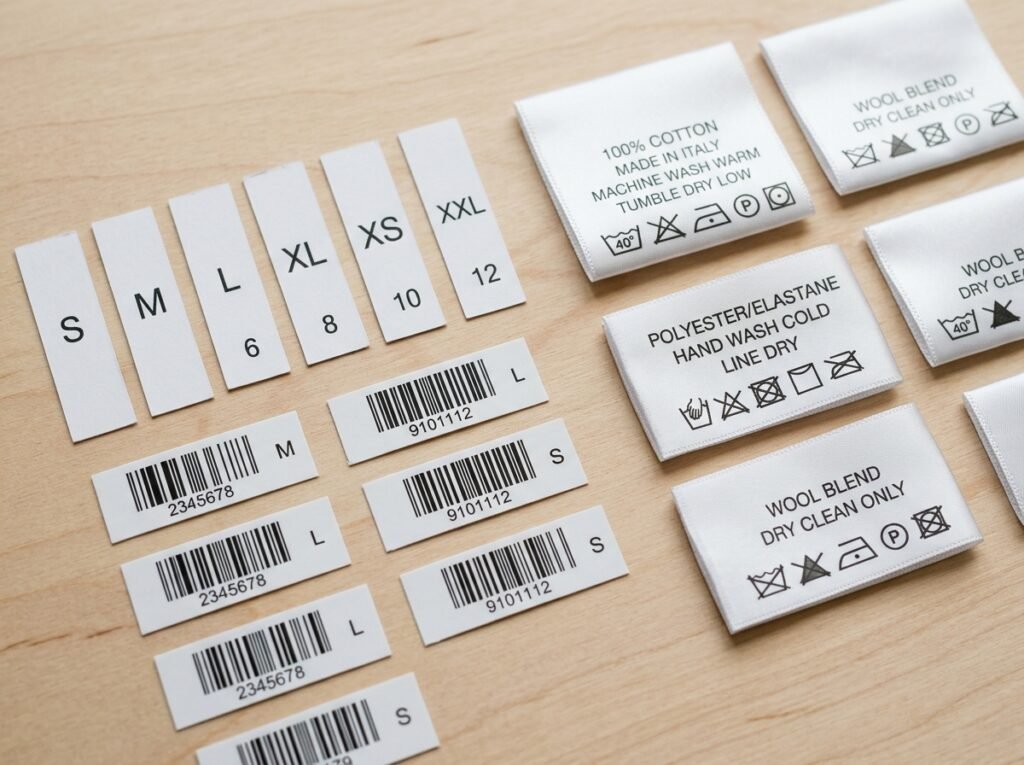
Why garment label type matters
A garment factory can use several labels for the same clothing item. A care label may communicate approved garment-care information, a size label identifies a particular size, and a barcode label may be part of inventory or retail handling. Although these items are often ordered together, they should not be treated as a single generic “clothing label.”
For a useful quotation, first establish the label’s function, material, finished dimensions, printed content and how it will be applied. Each choice affects what the supplier needs to review before confirming production.
Compare the five common label types
| Label type | Typical role | Essential buyer-supplied information |
|---|---|---|
| Care label | Communicates approved care information | Exact text/symbols, languages, material and size |
| Size label | Shows the brand’s specified size | Size set, typography, layout and format |
| Barcode label | Supports identification or scanning | Valid code data, symbology/artwork and label size |
| Joker label | Carries specified merchandising or handling information | Fields, variant rules and application purpose |
| QC label | Records or identifies quality-control information | Approved fields, layout and use in the workflow |
The Garment Labels category covers care, size, barcode, joker and QC label formats. Product names describe functions, not a promise that the same material and finishing method suits every format.
Care labels: accuracy comes before printing
Care information may be subject to brand requirements and regulations in the destination market. The supplier should reproduce approved instructions, not invent washing temperatures, fibre composition, symbols or translations. Buyers must supply or approve the final content and confirm who is responsible for regulatory accuracy.
Indicate whether the design needs multiple languages, how the information should be ordered and whether the label will be folded or attached in a particular way. Where legibility is important, review a physical sample at the intended finished size rather than assessing only a large digital preview.
Size, barcode and QC labels: plan variations
Many errors happen during variable-data production. If a clothing programme includes multiple sizes, colours, retail locations or SKU codes, create a spreadsheet listing each version and its required quantity. Do not send a collection of unlabelled files and assume the supplier can infer which data belong together.
For barcodes, provide the approved code information and any scanning requirements. If the artwork includes a barcode symbol, check that the printed size and surrounding layout meet the buyer’s scanning workflow. A graphic that looks correct on screen is not proof of scanning performance.
For QC labels, explain exactly which fields are needed and where the label is used. A label applied during internal inspection may have a different purpose from one intended to remain on the finished garment.
Choose material and finishing based on application
DV Trims lists paper and satin label materials within its documented product range. These options are not interchangeable in every application. Consider the intended attachment method, required appearance, feel, information density and handling conditions. Ask for samples if material behaviour or print clarity matters.
When preparing a specification, distinguish the material from the label format: “satin care label” describes both, while “care label” alone does not establish the substrate. Confirm whether the requested finished label is flat, folded or another buyer-approved format before final approval.
Garment labels are not the same as hang tags
A garment label may be sewn into or otherwise applied to a product as required by the buyer, whereas a hang tag usually serves as a removable presentation or product-information item. They often appear together, but their artwork and print specifications should be managed separately.
See our companion article, Hang Tags vs Garment Labels, for a side-by-side selection guide.
Prepare a simple artwork approval workflow
Use consistent item codes for every label. Provide the approved artwork, specify each size and material, and include a version sheet where text varies. Before bulk production, verify spelling, language, colour, dimensions, data fields and required finishing against the approved source files. Keep a final version identifier so neither party works from an outdated draft.
Buyer checklist
- Label type and intended use
- Material, finished size and finishing format
- Approved text, care symbols, barcode data or other variable information
- Quantity by version, size or SKU
- Artwork files and approval contact
- Packing requirements, destination and requested delivery terms
Example enquiry format: “Please quote garment labels: type [care/size/barcode/QC], material [ ], finished size [ ] mm, print [ ], number of artwork versions [ ], quantity per version [ ]. Approved artwork and data sheet attached.”
Frequently asked questions
Can one label cover care, size and barcode information? It depends on the buyer’s design and application requirements; first confirm the information, layout and intended use.
Who provides care instructions? The apparel brand or responsible buyer should provide or approve accurate care information and any required regulatory wording.
Why should I send quantities by variant? It prevents different sizes or codes from being mixed in quotation, production and packing.
Explore the available garment label options or use Request Samples to discuss the material, size and printed format.